Policy and Law
Sub-Competencies
- Understand and implement policy to meet local, state, and federal requirements and constitutional provisions, standards, and regulatory applications to promote student success.
- Recognize and apply standards of care involving civil and criminal liability for negligence, harassment, and intentional torts.
- Demonstrate an understanding of state, federal, and case law, and rules and regulations governing general education, special education, and community education.
Reflections and Artifacts
Summary: This artifact marks the beginning of using a QBS audit of a school system's AI implementation. This guide served as the starting point for an AI policy and implementation deep dive
Reflection: School leaders must be ready to bring the forefront of technology into the educational building for both their staff to use and students to learn about for the future. Artificial Intelligence, using a large language model (LLM), has sparked a new boom in technology and production. School systems have been encouraged at the state and national levels to begin implementing AI and are required to have an AI policy and procedure in place to ensure effective and appropriate use in their schools. As a school leader, I want to ensure that students and staff use technology safely, especially regarding student data. As part of this, I began an audit using the QBS audit packet to examine how AI is being used in Foley Public Schools and how closely the school district is following the policy and aligning with AI best practices. Through this process, I have begun creating a procedure manual for the district and have been advising staff on the laws and importance of data handling around an LLM.
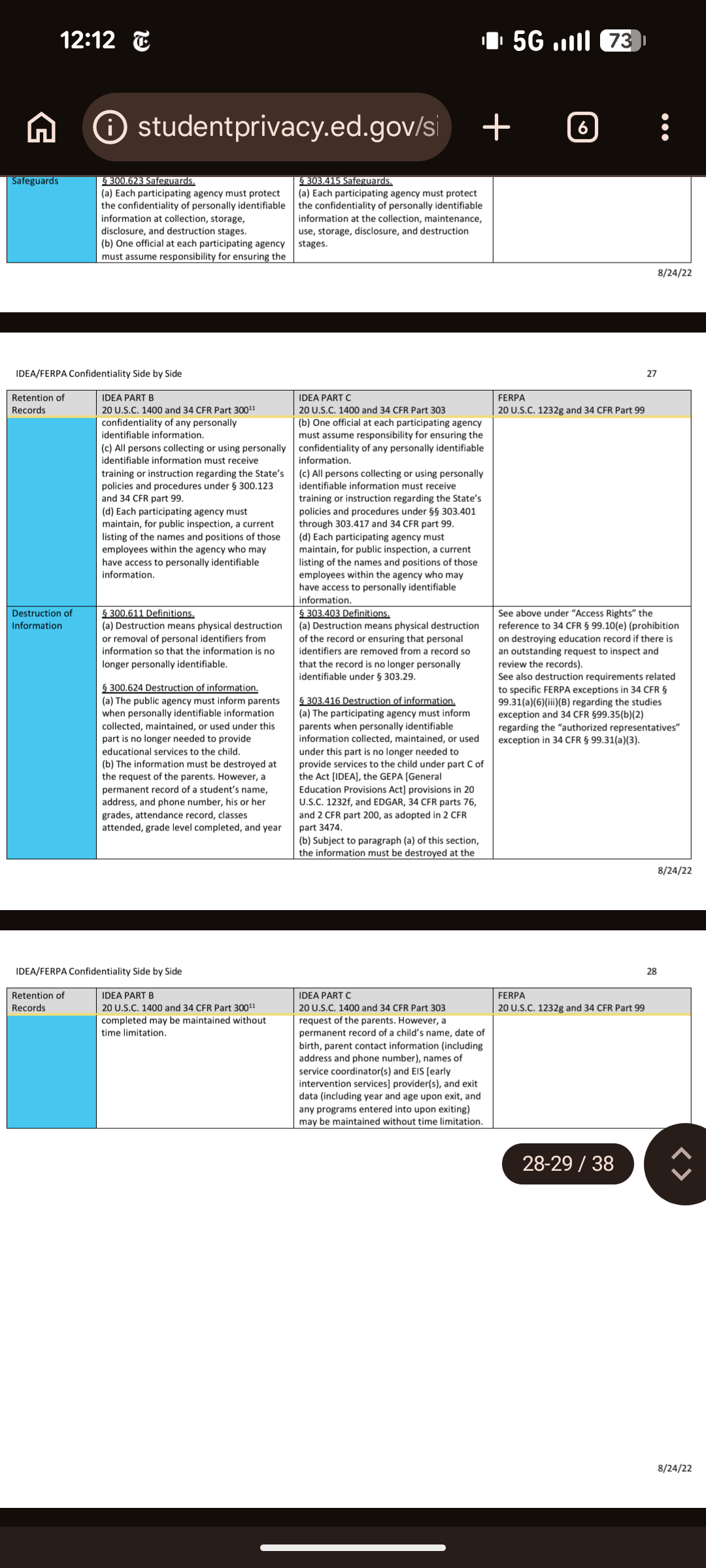
Summary: This artifact shows the specific laws regarding destruction and the definition of educational data that must be preserved.
Reflection: A school principal must ensure that all laws, policies, and procedures are being followed by everyone within their building. Part of that responsibility is ensuring that documents created as part of the educational record for students with IEPs are preserved in compliance with state and national laws. In discussions with building leadership and special education staff, I learned about new policies being implemented district-wide to ensure the preservation of education records, specifically regarding behavior-tracking point sheets. To understand this education law topic more deeply, I dove into relevant case law, focusing mainly on the language of IDEA and FERPA and on how those laws interact regarding data destruction. In this research, I learned about the vital importance of maintaining behavioral records. To help put this into action, I designed a process to batch-upload behavior documentation and created a plan that did not overwhelm special education teachers or their support staff.
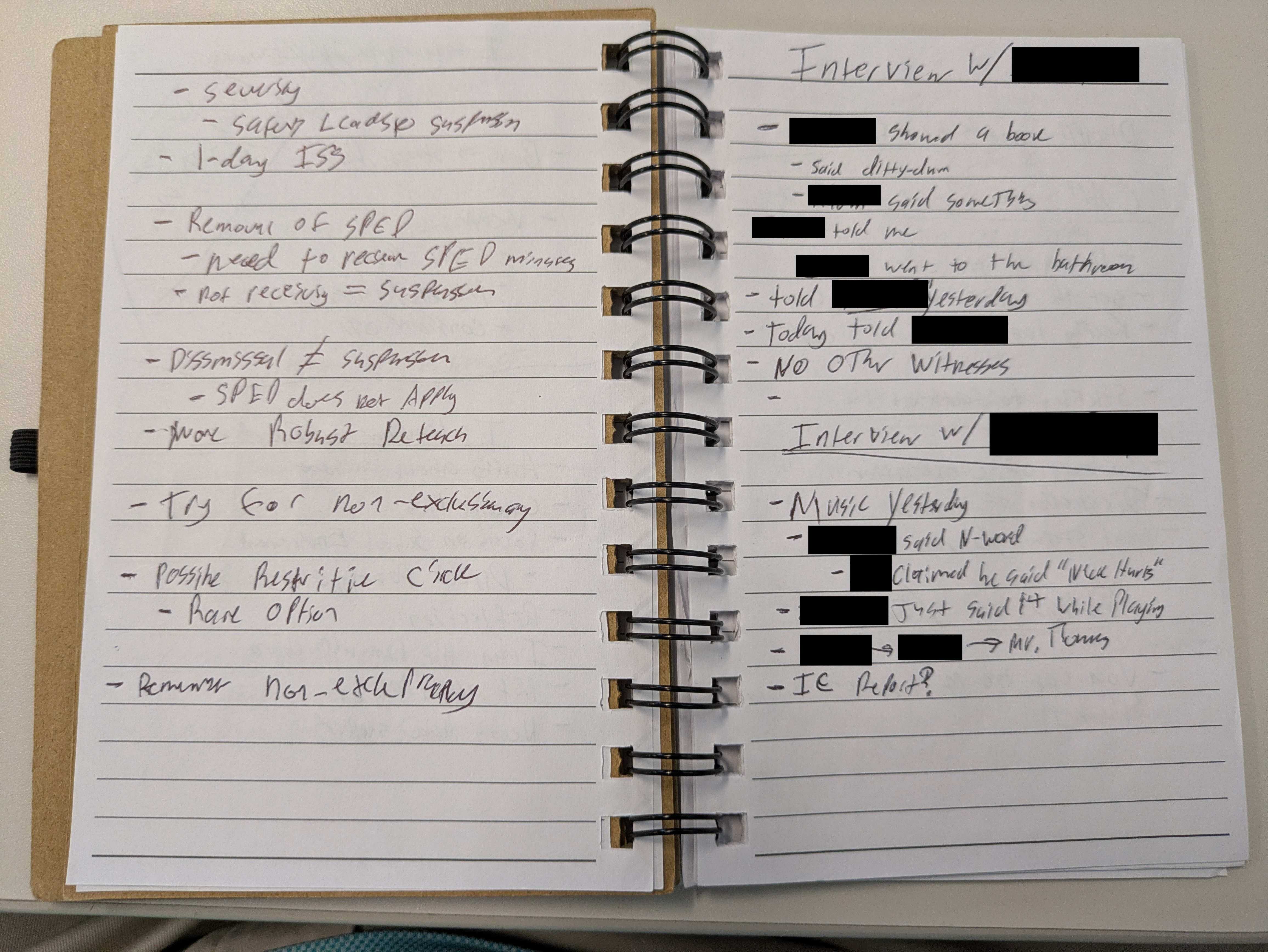
Summary: This artifact is the notes from my time shadowing a student conduct investigation into a student who used a racial slur. The investigation concluded with the assignment of an appropriate consequence under the student conduct handbook and the enforcement of compliance with anti-discrimination policies in the school district.
Reflection: School leaders must ensure they uphold an environment free from discrimination. During this experience, I worked through a student conduct investigation involving a few students, in which one student used a racial slur around another. From the investigation and the consequences applied, I learned about the importance of keeping education at the center of consequences. As important, however, is ensuring that all students feel safe, as a school leader with zero tolerance for discrimination.